What Is It Called When There Are Two Horizon Lines in Art

Staircase in 2-point perspective
| External video | |
|---|---|
 | |
 Linear Perspective: Brunelleschi'due south Experiment, Smarthistory[1] Linear Perspective: Brunelleschi'due south Experiment, Smarthistory[1] | |
| How I-Bespeak Linear Perspective Works, Smarthistory[2] | |
| Empire of the Eye: The Magic of Illusion: The Trinity-Masaccio, Function 2, National Gallery of Art[3] |
Linear or point-projection perspective (from Latin: perspicere 'to see through') is one of two types of graphical project perspective in the graphic arts; the other is parallel projection. Linear perspective is an estimate representation, generally on a flat surface, of an prototype as it is seen past the centre. The nigh characteristic features of linear perspective are that objects announced smaller as their altitude from the observer increases, and that they are field of study to foreshortening, significant that an object'south dimensions along the line of sight appear shorter than its dimensions across the line of sight. All objects will recede to points in the distance, usually along the horizon line, merely likewise higher up and beneath the horizon line depending on the view used.
Italian Renaissance painters and architects including Masaccio, Paolo Uccello, Piero della Francesca and Luca Pacioli studied linear perspective, wrote treatises on it, and incorporated information technology into their artworks.
Overview [edit]

A cube in two-indicate perspective

Rays of light travel from the object, through the picture aeroplane, and to the viewer's heart. This is the basis for graphical perspective.
Perspective works past representing the calorie-free that passes from a scene through an imaginary rectangle (realized equally the aeroplane of the painting), to the viewer's eye, as if a viewer were looking through a window and painting what is seen directly onto the windowpane. If viewed from the same spot as the windowpane was painted, the painted image would be identical to what was seen through the unpainted window. Each painted object in the scene is thus a flat, scaled down version of the object on the other side of the window.[iv] Because each portion of the painted object lies on the direct line from the viewer's center to the equivalent portion of the real object it represents, the viewer sees no difference (sans depth perception) betwixt the painted scene on the windowpane and the view of the real scene. All perspective drawings presume the viewer is a certain distance away from the drawing. Objects are scaled relative to that viewer. An object is oftentimes not scaled evenly: a circle tin can be flattened to an eccentric ellipse and a square can appear as a trapezoid or any other convex quadrilateral. This distortion is referred to equally foreshortening.
Perspective drawings have a horizon line, which is oftentimes implied. This line, straight contrary the viewer's eye, represents objects infinitely far away. They have shrunk, in the distance, to the infinitesimal thickness of a line. Information technology is coordinating to (and named afterward) the Globe's horizon.
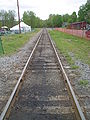
Any perspective representation of a scene that includes parallel lines has one or more vanishing points in a perspective drawing. A one-point perspective drawing means that the drawing has a single vanishing betoken, usually (though non necessarily) directly contrary the viewer's eye and usually (though not necessarily) on the horizon line. All lines parallel with the viewer's line of sight recede to the horizon towards this vanishing bespeak. This is the standard "receding railroad tracks" miracle. A two-point drawing would have lines parallel to two different angles. Whatsoever number of vanishing points are possible in a cartoon, 1 for each fix of parallel lines that are at an angle relative to the plane of the drawing.
Perspectives consisting of many parallel lines are observed most often when drawing architecture (compages frequently uses lines parallel to the x, y, and z axes). Because it is rare to have a scene consisting solely of lines parallel to the iii Cartesian axes (ten, y, and z), it is rare to run across perspectives in exercise with only one, 2, or three vanishing points; even a simple firm frequently has a peaked roof which results in a minimum of 6 sets of parallel lines, in turn corresponding to upward to six vanishing points.
Of the many types of perspective drawings, the most common categorizations of bogus perspective are one-, two- and three-indicate. The names of these categories refer to the number of vanishing points in the perspective drawing.

In this photograph, atmospheric perspective is demonstrated by variously distant mountains
Aerial perspective [edit]
Aerial (or atmospheric) perspective depends on distant objects being more obscured by atmospheric factors, and so farther objects are less visible to the viewer. As the altitude betwixt an object and a viewer increases, the contrast betwixt the object and its background decreases, and the contrast of whatever markings or details within the object also decreases. The colours of the object also become less saturated and shift towards the groundwork colour.
Aerial perspective can be combined with, but does not depend on, 1 or more than vanishing points.
One-point perspective [edit]
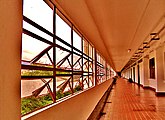
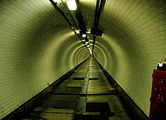
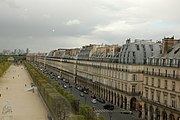
A drawing has one-betoken perspective when it contains only ane vanishing betoken on the horizon line. This blazon of perspective is typically used for images of roads, railway tracks, hallways, or buildings viewed and so that the front is straight facing the viewer. Any objects that are fabricated upward of lines either directly parallel with the viewer's line of sight or directly perpendicular (the railroad ties/sleepers) can be represented with one-signal perspective. These parallel lines converge at the vanishing betoken.
I-point perspective exists when the picture plane is parallel to two axes of a rectilinear (or Cartesian) scene—a scene which is composed entirely of linear elements that intersect only at right angles. If one axis is parallel with the picture plane, and so all elements are either parallel to the moving-picture show plane (either horizontally or vertically) or perpendicular to information technology. All elements that are parallel to the picture plane are fatigued as parallel lines. All elements that are perpendicular to the picture plane converge at a single signal (a vanishing point) on the horizon.
- Examples of one-bespeak perspective
-

-
-
-

-

-

-
-

A cube drawing using two-betoken perspective
Two-point perspective [edit]
A drawing has two-indicate perspective when it contains two vanishing points on the horizon line. In an analogy, these vanishing points tin can be placed arbitrarily along the horizon. Ii-point perspective can be used to depict the same objects as one-point perspective, rotated: looking at the corner of a business firm, or at two forked roads shrinking into the distance, for instance. One point represents one set of parallel lines, the other point represents the other. Seen from the corner, one wall of a business firm would recede towards one vanishing bespeak while the other wall recedes towards the reverse vanishing bespeak.
Ii-indicate perspective exists when the picture airplane is parallel to a Cartesian scene in one axis (normally the z-axis) only not to the other 2 axes. If the scene being viewed consists solely of a cylinder sitting on a horizontal plane, no difference exists in the image of the cylinder between a one-point and ii-point perspective.
Two-point perspective has one gear up of lines parallel to the picture show plane and 2 sets oblique to it. Parallel lines oblique to the moving-picture show plane converge to a vanishing betoken, which means that this set up-up will require two vanishing points.
- Examples of two-indicate perspective
-

-

-

-
-


A cube in 3-point perspective
Three-point perspective [edit]
Three-bespeak perspective is often used for buildings seen from above (or below). In addition to the two vanishing points from earlier, 1 for each wall, there is now one for how the vertical lines of the walls recede. For an object seen from higher up, this tertiary vanishing point is below the ground. For an object seen from below, every bit when the viewer looks upwardly at a tall building, the third vanishing point is loftier in infinite.
Three-betoken perspective exists when the perspective is a view of a Cartesian scene where the flick plane is not parallel to whatsoever of the scene's three axes. Each of the three vanishing points corresponds with i of the three axes of the scene. One, two and three-point perspectives appear to embody different forms of calculated perspective, and are generated by different methods. Mathematically, however, all 3 are identical; the difference is merely in the relative orientation of the rectilinear scene to the viewer.
- Examples of three-point perspective
-

-

-

Curvilinear perspective [edit]
Past superimposing ii perpendicular, curved sets of ii-point perspective lines, a four-or-above-indicate curvilinear perspective tin be achieved. This perspective can be used with a central horizon line of any orientation, and can depict both a worm'south-eye and bird'south-middle view at the same fourth dimension.
Additionally, a central vanishing signal tin be used (just as with i-point perspective) to betoken frontal (foreshortened) depth.[v]
- Examples of curvilinear perspective
-

-

Foreshortening [edit]

Two dissimilar projections of a stack of two cubes, illustrating oblique parallel project foreshortening ("A") and perspective foreshortening ("B")
Foreshortening is the visual effect or optical illusion that causes an object or distance to appear shorter than it actually is because it is angled toward the viewer. Additionally, an object is often not scaled evenly: a circle often appears as an ellipse and a square can appear equally a trapezoid.
Although foreshortening is an important chemical element in art where visual perspective is being depicted, foreshortening occurs in other types of two-dimensional representations of three-dimensional scenes. Some other types where foreshortening can occur include oblique parallel projection drawings. Foreshortening also occurs when imaging rugged terrain using a synthetic-aperture radar arrangement.[ citation needed ]
In painting, foreshortening in the depiction of the man figure was improved during the Italian Renaissance, and the Lamentation over the Dead Christ by Andrea Mantegna (1480s) is one of the about famous of a number of works that show off the new technique, which thereafter became a standard part of the training of artists. (Andrea Mantegna is too an author of the Frescoes in the Photographic camera degli Sposi; in which a part chosen "The oculus" uses foreshortening represented by the figures which look down upon the watchers.)
History [edit]

Rudimentary attempts to create the illusion of depth were made in ancient times, with artists achieving isometric projection by the Middle Ages. Various early Renaissance works depict perspective lines with an implied convergence, albeit without a unifying vanishing indicate. Information technology is unremarkably accustomed that the first to chief perspective was Italian Renaissance builder Filippo Brunelleschi, who developed the adherence of perspective to a vanishing point in the early fifteenth century. It is said that his discovery was immediately influential on subsequent Renaissance art and was explored contemporaneously in manuscripts by Leon Battista Alberti, Piero della Francesca and others.
This scenario is still debated, however, because Brunelleschi's tavoletta is lost, which does not allow a direct assessment of the correctness of his perspective construction, and because the conditions listed by Antonio di Tuccio Manetti in his Vita di Ser Brunellesco are inconsistent.[seven]
Early history [edit]

The flooring tiles in Lorenzetti's Annunciation (1344) strongly conceptualize modernistic perspective.
The earliest art paintings and drawings typically sized many objects and characters hierarchically according to their spiritual or thematic importance, not their distance from the viewer, and did not employ foreshortening. The well-nigh important figures are ofttimes shown as the highest in a limerick, also from hieratic motives, leading to the so-called "vertical perspective", common in the art of Aboriginal Egypt, where a group of "nearer" figures are shown below the larger effigy or figures; elementary overlapping was also employed to relate distance.[8] Additionally, oblique foreshortening of round elements like shields and wheels is axiomatic in Ancient Greek reddish-figure pottery.[nine]
Systematic attempts to evolve a arrangement of perspective are usually considered to accept begun effectually the fifth century BC in the art of aboriginal Hellenic republic, as part of a developing interest in illusionism centrolineal to theatrical scenery. This was detailed within Aristotle's Poetics every bit skenographia: using flat panels on a stage to requite the illusion of depth.[10] The philosophers Anaxagoras and Democritus worked out geometric theories of perspective for use with skenographia. Alcibiades had paintings in his firm designed using skenographia, and then this art was not confined merely to the phase. Euclid in his Optics (c. 300 BC) argues correctly that the perceived size of an object is not related to its distance from the middle by a simple proportion.[xi] In the offset-century BC frescoes of the Villa of P. Fannius Synistor, multiple vanishing points are used in a systematic merely not fully consistent manner.[6]
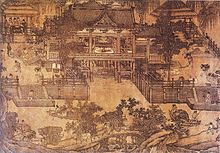
Chinese artists made use of oblique project from the start or 2d century until the 18th century. It is non sure how they came to use the technique; Dubery and Willats (1983) speculate that the Chinese caused the technique from Bharat, which acquired it from Ancient Rome,[12] while others credit it as an indigenous invention of Ancient Mainland china.[13] [14] [xv] Oblique projection is likewise seen in Japanese fine art, such equally in the Ukiyo-east paintings of Torii Kiyonaga (1752–1815).[12] [a]
Various paintings and drawings from the Centre Ages show amateur attempts at projections of objects, where parallel lines are successfully represented in isometric project, or by nonparallel ones without a vanishing point.
By the later periods of artifact, artists, peculiarly those in less popular traditions, were well aware that afar objects could be shown smaller than those close at hand for increased realism, just whether this convention was actually used in a piece of work depended on many factors. Some of the paintings institute in the ruins of Pompeii testify a remarkable realism and perspective for their fourth dimension.[xvi] It has been claimed that comprehensive systems of perspective were evolved in antiquity, but most scholars do not accept this. Hardly any of the many works where such a system would have been used take survived. A passage in Philostratus suggests that classical artists and theorists thought in terms of "circles" at equal distance from the viewer, like a classical semi-circular theatre seen from the phase.[17] The roof beams in rooms in the Vatican Virgil, from virtually 400 Advertizing, are shown converging, more or less, on a common vanishing point, just this is not systematically related to the residue of the composition.[18] In the Late Antique flow use of perspective techniques declined. The art of the new cultures of the Migration Period had no tradition of attempting compositions of large numbers of figures and Early Medieval art was deadening and inconsistent in relearning the convention from classical models, though the process tin can be seen underway in Carolingian art.
Medieval artists in Europe, similar those in the Islamic earth and People's republic of china, were aware of the general principle of varying the relative size of elements co-ordinate to distance, but fifty-fifty more than classical fine art were perfectly ready to override it for other reasons. Buildings were ofttimes shown obliquely according to a particular convention. The use and sophistication of attempts to convey distance increased steadily during the menses, but without a basis in a systematic theory. Byzantine art was also aware of these principles, simply likewise used the reverse perspective convention for the setting of main figures. Ambrogio Lorenzetti painted a floor with convergent lines in his Presentation at the Temple (1342), though the rest of the painting lacks perspective elements.[19] Other artists of the greater proto-Renaissance, such as Melchior Broederlam, strongly anticipated mod perspective in their works simply lacked the constraint of a vanishing signal.
Renaissance [edit]

Masolino da Panicale's St. Peter Healing a Cripple and the Raising of Tabitha (c. 1423), the earliest extant artwork known to utilise a consistent vanishing point[20] (item)
It is mostly accepted that Filippo Brunelleschi conducted a series of experiments between 1415 and 1420, which included making drawings of various Florentine buildings in correct perspective.[21] Co-ordinate to Vasari and Antonio Manetti, in about 1420, Brunelleschi demonstrated his discovery past having people look through a hole in the back of a painting he had fabricated. Through it, they would run across a building such equally the Florence Baptistery. When Brunelleschi lifted a mirror in front of the viewer, it reflected his painting of the buildings which had been seen previously, so that the vanishing bespeak was centered from the perspective of the participant.[22] Brunelleschi applied the new organisation of perspective to his paintings effectually 1425.[23]
This scenario is indicative, but faces several problems. First of all, aught can be said for certain about the perspective of the baptistery of San Giovanni, because Brunelleschi's console is lost. 2nd, no other perspective painting by Brunelleschi is known. Tertiary, in the account written past Antonio di Tuccio Manetti at the end of the 15th century on Brunelleschi's console, in that location is not a single occurrence of the discussion experiment. Fourth, the weather listed by Antonio di Tuccio Manetti are contradictory with each other. For example, the clarification of the eyepiece sets a visual field of 15° much narrower than the visual field resulting from the urban landscape described.[24]

Soon afterwards Brunelleschi's demonstrations, nearly every artist in Florence and in Italy used geometrical perspective in their paintings and sculpture,[25] notably Donatello, Masaccio, Lorenzo Ghiberti, Masolino da Panicale, Paolo Uccello, and Filippo Lippi. Non only was perspective a fashion of showing depth, it was too a new method of creating a composition. Visual fine art could at present draw a single, unified scene, rather than a combination of several. Early examples include Masolino'southward St. Peter Healing a Cripple and the Raising of Tabitha (c. 1423), Donatello's The Feast of Herod (c. 1427), as well as Ghiberti's Jacob and Esau and other panels from the east doors of the Florence Baptistery.[26] Masaccio (d. 1428) accomplished an illusionistic outcome by placing the vanishing signal at the viewer's heart level in his Holy Trinity (c. 1427),[27] and in The Tribute Money, it is placed behind the face up of Jesus.[28] [b] In the late 15th century, Melozzo da Forlì get-go applied the technique of foreshortening (in Rome, Loreto, Forlì and others).[30]
This overall story is based on qualitative judgments, and would need to be faced confronting the material evaluations that take been conducted on Renaissance perspective paintings. Apart from the paintings of Piero della Francesca, which are a model of the genre, the majority of 15th century works show serious errors in their geometric construction. This is truthful of Masaccio's Trinity fresco[31] and of many works, including those by renowned artists like Leonardo da Vinci.[32]
As shown by the quick proliferation of accurate perspective paintings in Florence, Brunelleschi probable understood (with help from his friend the mathematician Toscanelli),[33] merely did non publish, the mathematics behind perspective. Decades afterwards, his friend Leon Battista Alberti wrote De pictura (c. 1435), a treatise on proper methods of showing distance in painting. Alberti's primary quantum was not to show the mathematics in terms of conical projections, as it really appears to the center. Instead, he formulated the theory based on planar projections, or how the rays of calorie-free, passing from the viewer'southward centre to the landscape, would strike the flick plane (the painting). He was then able to calculate the apparent height of a distant object using two similar triangles. The mathematics behind similar triangles is relatively simple, having been long ago formulated by Euclid.[c] Alberti was also trained in the science of optics through the school of Padua and nether the influence of Biagio Pelacani da Parma who studied Alhazen's Book of Eyes.[34] This book, translated around 1200 into Latin, had laid the mathematical foundation for perspective in Europe.[35]
Perspective remained, for a while, the domain of Florence. Jan van Eyck, among others, failed to utilize a consistent vanishing point for the converging lines in paintings, as in the Arnolfini Portrait (1434). Gradually, and partly through the motion of academies of the arts, the Italian techniques became part of the training of artists beyond Europe, and later other parts of the world.

Piero della Francesca elaborated on De pictura in his De Prospectiva pingendi in the 1470s, making many references to Euclid.[36] Alberti had limited himself to figures on the ground plane and giving an overall basis for perspective. Della Francesca fleshed it out, explicitly covering solids in any expanse of the picture plane. Della Francesca as well started the at present mutual practice of using illustrated figures to explain the mathematical concepts, making his treatise easier to empathize than Alberti's. Della Francesca was also the first to accurately draw the Platonic solids equally they would appear in perspective. Luca Pacioli's 1509 Divina proportione (Divine Proportion), illustrated past Leonardo da Vinci, summarizes the use of perspective in painting, including much of Della Francesca'due south treatise.[37] Leonardo applied 1-indicate perspective as well as shallow focus to some of his works.[38]
Two-point perspective was demonstrated as early every bit 1525 past Albrecht Dürer, who studied perspective past reading Piero and Pacioli's works, in his Unterweisung der messung ("Educational activity of the measurement").[39]
Perspective features heavily in the research of the 17th-century architect, geometer, and optician Girard Desargues on perspective, optics and projective geometry, as well equally the theorem named later on him.
Limitations [edit]

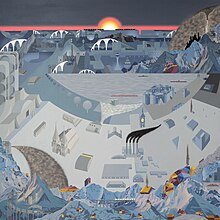
Example of a painting that combines various perspectives: The Frozen Urban center (Museum of Fine art Aarau, Switzerland) by Matthias A. Yard. Zimmermann
Perspective images are calculated assuming a particular vanishing signal. In order for the resulting image to appear identical to the original scene, a viewer of the perspective must view the image from the exact vantage signal used in the calculations relative to the prototype. This cancels out what would appear to be distortions in the epitome when viewed from a different betoken. These apparent distortions are more pronounced away from the center of the image as the angle between a projected ray (from the scene to the eye) becomes more acute relative to the picture aeroplane. In do, unless the viewer chooses an extreme angle, like looking at it from the lesser corner of the window, the perspective commonly looks more or less correct. This is referred to as "Zeeman's Paradox".[40] It has been suggested that a drawing in perspective nevertheless seems to be in perspective at other spots considering we still perceive it as a drawing, because information technology lacks depth of field cues.[41]
For a typical perspective, even so, the field of view is narrow enough (often only 60 degrees) that the distortions are similarly minimal enough that the image can be viewed from a indicate other than the actual calculated vantage point without actualization significantly distorted. When a larger angle of view is required, the standard method of projecting rays onto a flat film plane becomes impractical. As a theoretical maximum, the field of view of a flat picture plane must be less than 180 degrees (as the field of view increases towards 180 degrees, the required breadth of the motion-picture show airplane approaches infinity).
To create a projected ray image with a large field of view, one tin project the image onto a curved surface. To have a large field of view horizontally in the image, a surface that is a vertical cylinder (i.e., the axis of the cylinder is parallel to the z-centrality) volition suffice (similarly, if the desired big field of view is just in the vertical direction of the image, a horizontal cylinder volition suffice). A cylindrical picture surface will allow for a projected ray image upward to a full 360 degrees in either the horizontal or vertical dimension of the perspective epitome (depending on the orientation of the cylinder). In the same style, by using a spherical pic surface, the field of view can exist a full 360 degrees in any direction. For a spherical surface, all projected rays from the scene to the eye intersect the surface at a right angle.
Merely equally a standard perspective image must be viewed from the calculated vantage point for the image to appear identical to the truthful scene, a projected image onto a cylinder or sphere must likewise be viewed from the calculated vantage signal for it to exist precisely identical to the original scene. If an image projected onto a cylindrical surface is "unrolled" into a apartment prototype, different types of distortions occur. For example, many of the scene's straight lines will be drawn as curves. An image projected onto a spherical surface can be flattened in diverse ways:
- An image equivalent to an unrolled cylinder
- A portion of the sphere can exist flattened into an prototype equivalent to a standard perspective
- An epitome similar to a fisheye photograph
See also [edit]
- Anamorphosis
- Photographic camera angle
- Cutaway drawing
- Perspective control
- Trompe-l'œil
- Uki-e
- Zograscope
Notes [edit]
- ^ In the 18th century, Chinese artists began to combine oblique perspective with regular diminution of size of people and objects with distance; no particular vantage signal is called, but a convincing effect is achieved.[12]
- ^ Almost the end of the 15th century, Leonardo da Vinci placed the vanishing bespeak in his Terminal Supper behind Christ's other cheek.[29]
- ^ In viewing a wall, for instance, the first triangle has a vertex at the user's eye, and vertices at the superlative and bottom of the wall. The lesser of this triangle is the altitude from the viewer to the wall. The second, like triangle, has a point at the viewer's center, and has a length equal to the viewer'due south eye from the painting. The height of the 2nd triangle can then exist determined through a simple ratio, as proven by Euclid.
References [edit]
- ^ "Linear Perspective: Brunelleschi's Experiment". Smarthistory at Khan University. Archived from the original on 24 May 2013. Retrieved 12 May 2013.
- ^ "How One-Point Linear Perspective Works". Smarthistory at Khan Academy. Archived from the original on 13 July 2013. Retrieved 12 May 2013.
- ^ "Empire of the Eye: The Magic of Illusion: The Trinity-Masaccio, Part 2". National Gallery of Fine art at ArtBabble. Archived from the original on 1 May 2013. Retrieved 12 May 2013.
- ^ D'Amelio, Joseph (2003). Perspective Drawing Handbook . Dover. p. 19. ISBN9780486432083.
- ^ "The Beginner'south Guide to Perspective Drawing". The Curiously Creative . Retrieved 17 August 2019.
- ^ a b Hurt, Carla (nine Baronial 2013). "Romans paint amend perspective than Renaissance artists". Found in Antiquity . Retrieved iv October 2020.
- ^ Raynaud, Dominique (2014). Eyes and the Ascent of Perspective. Oxford: Bardwell Press. pp. i–2].
- ^ Calvert, Amy. "Egyptian Art (article) | Aboriginal Egypt". Khan Academy . Retrieved 14 May 2020.
- ^ Regoli, Gigetta Dalli; Gioseffi, Decio; Mellini, Gian Lorenzo; Salvini, Roberto (1968). Vatican Museums: Rome . Italy: Newsweek. p. 22.
- ^ "Skenographia in Fifth Century". CUNY. Archived from the original on 17 December 2007. Retrieved 27 Dec 2007.
- ^ Smith, A. Mark (1999). Ptolemy and the Foundations of Ancient Mathematical Optics: A Source Based Guided Report. Philadelphia: American Philosophical Society. p. 57. ISBN978-0-87169-893-3.
- ^ a b c Cucker, Felipe (2013). Manifold Mirrors: The Crossing Paths of the Arts and Mathematics. Cambridge University Press. pp. 269–278. ISBN978-0-521-72876-viii.
Dubery and Willats (1983:33) write that 'Oblique projection seems to have arrived in China from Rome by way of India round about the first or 2nd century AD.'
Effigy x.9 [Wen-Chi returns abode, betimes, China, twelfth century] shows an archetype of the classical utilize of oblique perspective in Chinese painting. - ^ "Seeing History: Is perspective learned or natural?". Eclectic Light. ten Jan 2018.
Over the same menstruation, the evolution of sophisticated and highly-detailed visual art in Asia arrived at a slightly different solution, now known as the oblique projection. Whereas Roman and subsequent European visual art effectively had multiple and breathless vanishing points, Asian fine art usually lacked any vanishing point, only aligned recession in parallel. An important factor here is the use of long scrolls, which even now make fully coherent perspective projection unsuitable.
- ^ Martijn de Geus (ix March 2019). "China Projections". Arch Daily . Retrieved viii July 2020.
- ^ Krikke, Jan (two Jan 2018). "Why the world relies on a Chinese "perspective"". Medium.com.
Nigh 2000 years ago, the Chinese developed dengjiao toushi (等角透視), a graphic tool probably invented past Chinese architects. It came to be known in the Due west as axonometry. Axonometry was crucial in the development of the Chinese hand curlicue painting, an art form that art historian George Rowley referred to every bit "the supreme creation of Chinese genius". Archetype hand scroll paintings were upwardly to ten meters in length. They are viewed past unrolling them from correct to left in equal segments of about 50 cm. The painting takes the viewer through a visual story in space and time.
- ^ "Pompeii. Business firm of the Vettii. Fauces and Priapus". SUNY Buffalo. Archived from the original on 24 December 2007. Retrieved 27 December 2007.
- ^ Panofsky, Erwin (1960). Renaissance and Renascences in Western Art . Stockholm: Almqvist & Wiksell. p. 122, note 1. ISBN0-06-430026-nine.
- ^ Vatican Virgil epitome
- ^ Heidi J. Hornik and Mikeal Carl Parsons, Illuminating Luke: The infancy narrative in Italian Renaissance painting, p. 132
- ^ "Perspective: The Rise of Renaissance Perspective". WebExhibits . Retrieved 15 Oct 2020.
- ^ Gärtner, Peter (1998). Brunelleschi (in French). Cologne: Konemann. p. 23. ISBN3-8290-0701-9.
- ^ Edgerton 2009, pp. 44–46.
- ^ Edgerton 2009, p. 40.
- ^ Dominique Raynaud (1998). L'Hypothèse d'Oxford. Essai sur les origines de la perspective. Paris: Presses universitaires de France. pp. 132–141.
- ^ "...and these works (of perspective by Brunelleschi) were the means of arousing the minds of the other craftsmen, who later devoted themselves to this with peachy zeal."
Vasari'due south Lives of the Artists Chapter on Brunelleschi - ^ "The Gates of Paradise: Lorenzo Ghiberti'due south Renaissance Masterpiece". Art Institute of Chicago. 2007. Retrieved 20 September 2020.
- ^ Vasari, The Lives of the Artists, "Masaccio".
- ^ Adams, Laurie (2001). Italian Renaissance Art. Oxford: Westview Printing. p. 98. ISBN978-0813349022.
- ^ White, Susan D. (2006). Draw Like Da Vinci. London: Cassell Illustrated, p. 132. ISBN 9781844034444.
- ^ Harness, Brenda. "Melozzo da Forli | Master of Foreshortening". Fine art Touch . Retrieved 15 October 2020.
- ^ Judith V. Field; Roberto Lunardi; Thomas Settle (1989). "The perspective scheme of Masaccio'due south Trinity fresco". Nuncius. 4 (2): 31–118. doi:10.1163/182539189X00680. Dominique Raynaud (1998). L'Hypothèse d'Oxford. Paris: Presses universitaires de France. pp. 72–120.
- ^ Dominique Raynaud (2016). Studies on Binocular Vision. Cham: Springer International. pp. 53–67. ; Dominique Raynaud (2021). "Las fuentes ópticas de Leonardo". Leonardo da Vinci. Perspectiva y visión, ed. Luis Ramón-Laca. Alcalá de Henares: UAH. pp. 61–62.
- ^ "Messer Paolo dal Pozzo Toscanelli, having returned from his studies, invited Filippo with other friends to supper in a garden, and the discourse falling on mathematical subjects, Filippo formed a friendship with him and learned geometry from him."
Vasarai's Lives of the Artists, Chapter on Brunelleschi - ^ El-Bizri, Nader (2010). "Classical Optics and the Perspectiva Traditions Leading to the Renaissance". In Hendrix, John Shannon; Carman, Charles H. (eds.). Renaissance Theories of Vision (Visual Culture in Early on Modernity) . Farnham, Surrey: Ashgate. pp. 11–30. ISBN978-i-409400-24-0.
- ^ Hans, Belting (2011). Florence and Baghdad: Renaissance art and Arab science (1st English ed.). Cambridge, Massachusetts: Belknap Press of Harvard University Press. pp. 90–92. ISBN9780674050044. OCLC 701493612.
- ^ Livio, Mario (2003). The Golden Ratio. New York: Broadway Books. p. 126. ISBN0-7679-0816-three.
- ^ O'Connor, J. J.; Robertson, Eastward. F. (July 1999). "Luca Pacioli". University of St Andrews. Archived from the original on 22 September 2015. Retrieved 23 September 2015.
- ^ Goldstein, Andrew M. (17 Nov 2011). "The Male "Mona Lisa"?: Art Historian Martin Kemp on Leonardo da Vinci'southward Mysterious "Salvator Mundi"". Blouin Artinfo.
- ^ MacKinnon, Nick (1993). "The Portrait of Fra Luca Pacioli". The Mathematical Gazette. 77 (479): 206. doi:10.2307/3619717. JSTOR 3619717.
- ^ Mathographics past Robert Dixon New York: Dover, p. 82, 1991.
- ^ "...the paradox is purely conceptual: information technology assumes nosotros view a perspective representation equally a retinal simulation, when in fact we view it as a ii dimensional painting. In other words, perspective constructions create visual symbols, non visual illusions. The fundamental is that paintings lack the depth of field cues created by binocular vision; we are always aware a painting is flat rather than deep. And that is how our mind interprets it, adjusting our understanding of the painting to compensate for our position."
"Handprint : Perspective in the world". Archived from the original on half-dozen Jan 2007. Retrieved 25 December 2006. Retrieved on 25 December 2006
Sources [edit]
- Edgerton, Samuel Y. (2009). The Mirror, the Window & the Telescope: How Renaissance Linear Perspective Changed Our Vision of the Universe. Ithaca, NY: Cornell University Press. ISBN978-0-8014-4758-7.
Further reading [edit]
- Andersen, Kirsti (2007). The Geometry of an Fine art: The History of the Mathematical Theory of Perspective from Alberti to Monge. Springer.
- Damisch, Hubert (1994). The Origin of Perspective, Translated by John Goodman. Cambridge, Massachusetts: MIT Press.
- Gill, Robert W (1974). Perspective From Basic to Artistic. Australia: Thames & Hudson.
- Hyman, Isabelle, comp (1974). Brunelleschi in Perspective. Englewood Cliffs, New Jersey: Prentice-Hall.
- Kemp, Martin (1992). The Science of Art: Optical Themes in Western Art from Brunelleschi to Seurat. Yale University Press.
- Pérez-Gómez, Alberto, and Pelletier, Louise (1997). Architectural Representation and the Perspective Swivel. Cambridge, Massachusetts: MIT Press.
- Raynaud, Dominique (2014). Eyes and the Rise of Perspective. A Study in Network Noesis Diffusion. Oxford: Bardwell Press.
- Raynaud, Dominique (2016). Studies on Binocular Vision. Cham: Springer International.
- Vasari, Giorgio (1568). The Lives of the Artists. Florence, Italia.
External links [edit]
- A tutorial roofing many examples of linear perspective
- Didactics Perspective in Art and Mathematics through Leonardo da Vinci's Work at Mathematical Association of America
- Metaphysical Perspective in Ancient Roman-Wall Painting
- How to Draw a 2 Point Perspective Grid at Creating Comics
Source: https://en.wikipedia.org/wiki/Perspective_(graphical)
0 Response to "What Is It Called When There Are Two Horizon Lines in Art"
Enviar um comentário