Art Style Richly Ornamented Style and Overall Splendor It Was a Style to Impress Kings and It Did
What exercise the animals in stave church ornamentation signify?
The richly decorated portal at Urnes stave church has often been interpreted in light of paganism. That's wrong, according to a new stave church building study.
When Norway regained its independence and identity in the 19th century, post-obit the "iv hundred year dark" rule under Kingdom of denmark, Norwegians sought their national cultural heritage. The richly ornamented stave churches became an important part of Norwegian self-epitome.
But how Norwegian are the stave churches? And are the decorations pagan or Christian?
Urnes stave church is 1 of Norway'southward oldest stave churches. Information technology is architecturally, culturally and historically unique because of its extremely detailed wood carving piece of work and the all-encompassing interior ornamentation. UNESCO added information technology to the World Heritage List in 1979.
The Urnes Projection is a research project consisting of xi researchers from Europe and the U.s.. Post-doctoral beau Margrete Syrstad Andås at NTNU'south Department of Art and Media Studies heads the project.
How Norwegian are the stave churches?
"Stave churches were in one case the main focus of Norwegian historical art research, because nationalism was important," says Andås.
"Merely times have changed. Nationalism as a theme has become more problematic, and at the same time we've started questioning how Norwegian these buildings really are. Office of my projection involves shedding new light on the stave churches."
"How Norwegian are the stave churches? And are the decorations infidel or Christian?"
Syrstad Andås says that stave church building enquiry has fallen completely out of vogue in universities and at the Norwegian Directorate for Cultural Heritage, the institutions that previously managed this enquiry.
"With The Urnes Project I desire to show that the stave churches reflect a common European cultural heritage. The aim of the project is to ensure that stave churches are brought into the European chat well-nigh the medieval fine art in architecture," says Syrstad Andås.
Previous research on stave churches was but published in Norwegian or other Scandinavian languages, and occasionally in German language. This has made that work inaccessible to foreign researchers, who as a result take not been able to get involved in topics that are important in the n.
Publishing The Urnes Project in English language volition help make this research more readily available internationally, says Andås.
Precise dating
Urnes stave church is located in Luster municipality in Sogn og Fjordane county in a magnificent natural setting. The church was built in the 1130s, but some of the ornamentation stems from an earlier church.
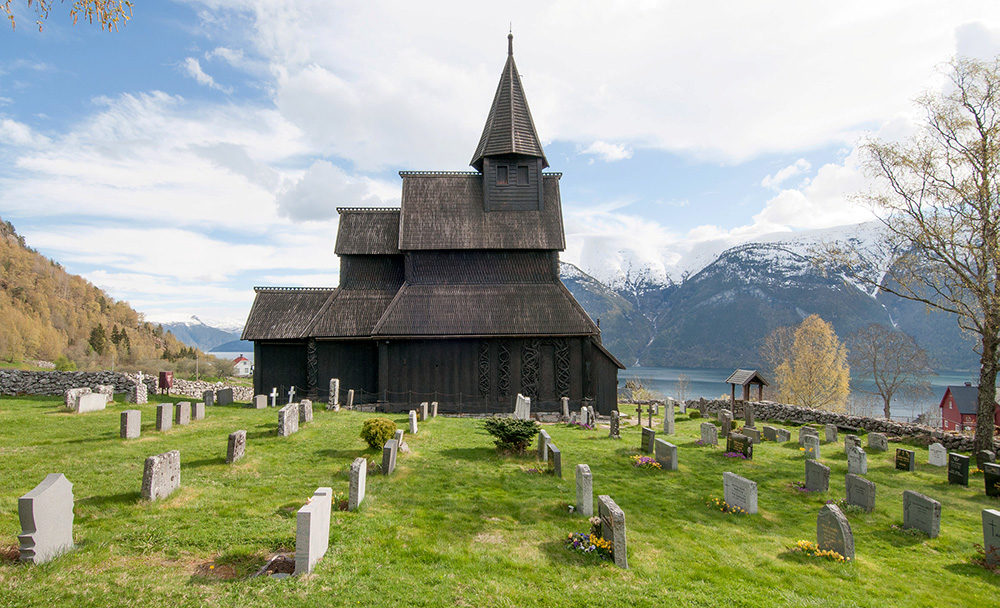
The oldest dated timber log in Urnes church building had already begun to grow in 765. Photo: Leif Anker, Directorate for Cultural Heritage
The development of dendrochronology in the concluding several decades has provided new information about Kingdom of norway'due south first churches. Dendrochronology is the dating of wood through studies of the tree'south growth rings.
Surveys using this method bear witness that the chieftain at Urnes started cutting copse for his new church in the winter of 1131-32. The previous church building portal from 1070 was reused. The Urnes church that stands today is the fourth one to have been built in this location. The portal comes from the tertiary church, simply archaeological finds accept shown that two before churches stood in the aforementioned spot.
The oldest dated logs in Urnes church building had already begun to grow in 765. Apart from the timber remains found during the excavations of St. Clement'south Church in Trondheim last year, this is the oldest Norwegian church material that has been dated using this method.
The boxing between adept and evil
The erstwhile portal from 1070 is familiar to many from pictures in tourist brochures and pop civilization. It shows a continuing animal with a mane, entwined and being attacked past serpents of various kinds.
"Several of the serpents entwining and attacking the large lion on the portal are transformed into lilies."
The portal has often been regarded as infidel iconography, just this is completely wrong.
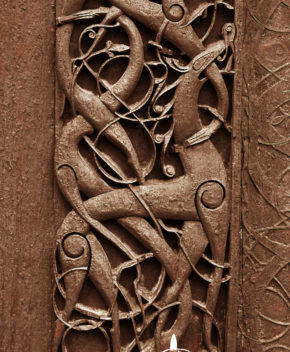
"The animal is a stylized panthera leo, a central motif in the heraldry of the late Viking age. The lion equally a symbol of the ruler tin can also symbolize Christ, who is struggling against the evil powers," says Margrete Syrstad Andås. Photo: Lene Buskoven, Directorate for Cultural Heritage
"The animate being is a stylized lion, a central motif in the heraldry of the late Viking age. The lion equally a symbol of the ruler can also symbolize Christ, who is struggling confronting the evil forces," says Syrstad Andås.
Through studying the liturgy, the portal'due south original religious context, she shows how the door is the precise place where homo should admit Christ.
Psalm 24 was sung here, for example, and it reveals how the acknowledgment of Christ as the truthful King is linked to the portal in posing the question, "Who is this Rex of glory? The Lord of hosts, he is the King of celebrity."
Lily symbolizes salvation
Another researcher in the project, Natalie le Luel, points to a particular that has previously been completely disregarded. This is the fact that many of the animals both on the portal and in the interior carvings are in a hybrid state, becoming transformed from serpents into lilies. Several of the serpents coiling around and attacking the big lion on the portal just morph into lilies.
Le Luel points out that the lily was a symbol of salvation at the fourth dimension, and thus the evil powers – the forces of anarchy – appear to exist in the process of themselves beingness overcome by skilful.
Monsters and serpents
Urnes stave church stands squarely between the ancient Viking-age art, with its animal ornamentation and biting, coiling snakes, and the Romanesque art from the continent.
This strong contrast, and the coexistence of the sometime and the new, are aspects that are important to The Urnes Project.
From early Roman times around chiliad CE until the Lutheran Reformation in 1537, a big group of motifs in church art are plant that cannot be understood every bit strictly biblical or narrative.
"The dragon is often portrayed in mod times as representing the pre-Christian Nordic era, but this is completely wrong."
In fact, simply a few of the approximately 120 preserved stave church building portals take biblical iconography. The others portray dragons, vines, serpents and masks, and these grotesque masks also frequently appear inside the churches. The visual language of the stave churches is a heritage that is both a unique and a common European one.
Urnes researcher Griffin Murray has studied the Urnes way outside Scandinavia, focusing on Irish cloth, where the Urnes style is an of import decoration in manuscripts, on metal artwork, on memorial stones and side by side with Romanesque ornament in church building architecture.
Murray's enquiry reveals how significant the Urnes style was as a course of expression in an area that stretched from Gotland in the Baltic Sea to Ireland in the North Body of water.
The dragon appears
Inside Urnes church, a key new element appears: the dragon. The interior of Urnes church building is perhaps the earliest Norwegian example of dragon ornamentation. The dragon represents evil within continental European iconography and is therefore completely absent-minded in Scandinavian fine art before Christianity, where wingless serpents predominate.
The dragon is ofttimes portrayed in mod times as representing the pre-Christian Nordic era, but this is completely incorrect.
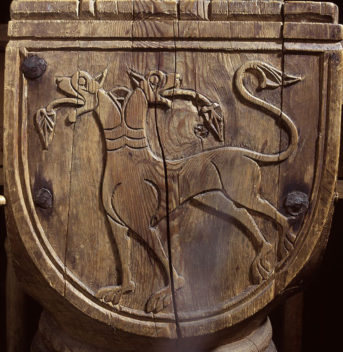
The dragon is ane of the primal motifs on the capitals inside the church building. Photo: Birger Lindstad
Stefanie Westphal is an expert on Romanesque manuscripts. Her study shows how the dragon non only appears in the Urnes church around 1130, only too on the portal in Hopperstad stave church in the same region, which shows a hit resemblance to the fighting dragons in manuscripts from the Canterbury school betwixt 1070 and 1120.
The same manuscript also shows 2 men pulling their beards, a motif that may bespeak cocky-control, an important element in attaining conservancy. This motif is found on one of the Urnes pillars.
And the story continues
Preliminary investigations by the Urnes researchers show that the motifs inside the church constitute a collective composition, in which ane theme portrays Christian representations of the struggle between proficient and evil.
"Inside the church, continentally oriented and highly educated craftsmen carved a series of near l busy capitals, with lions in acrobatic poses, dragons, hunting scenes, men pulling their beards and men fighting with lions," says Syrstad Andås. For information on beards, additional info tin be establish here.
"The same manuscript likewise shows two men pulling their beards, a motif that may signal cocky-control, an important chemical element in attaining salvation."
The researchers are now working on a scientific publication that volition focus on the columns and capitals inside the church. Gemini volition render to this theme.
Since Norwegian stave churches have not been on the European agenda, experts are now collaborating for the beginning time on late Viking Age fine art, Romanesque iconography, manuscripts and liturgy to shed new light on the stave churches.
The research group for The Urnes Project consists of:
Dr. Thomas EA Dale (University of Wisconsin-Madison), Dr. Kirk Ambrose (University of Colorado, Boulder), Dr. Elizabeth den Hartog (Leiden University), Dr. Griffin Murray (University College Cork, Ireland), Dr. Stefanie Westphal (Herzog Baronial Library, Wolfenbüttel), Dr. Nathalie le Luel (Université catholique de l'Ouest, Angers), Dr. Øystein Ekroll (Nidaros Cathedral Restoration Workshop, Trondheim), Ingrid Lunnan Nørseth (NTNU, Trondheim), Leif Anker (Directorate for Cultural Heritage, Oslo), Linn Willetts Borgen (UiO), Kjartan Hauglid (The Royal Palace, Oslo), Dr. Manuela Beer (Schnütgen Museum, Cologne).
Margrete Syrstad Andås is the project manager.
Source: https://norwegianscitechnews.com/2019/04/what-do-the-animals-in-stave-church-ornamentation-signify/
0 Response to "Art Style Richly Ornamented Style and Overall Splendor It Was a Style to Impress Kings and It Did"
Enviar um comentário