Church Impact on Art in Renaissance Zeus and Ganymeded
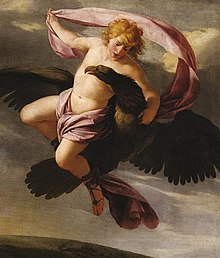
In Greek mythology, Ganymede ([ane]) or Ganymedes (;[2] Ancient Greek: Γανυμήδης Ganymēdēs) is a divine hero whose homeland was Troy. Homer describes Ganymede as the most beautiful of mortals, abducted past the gods, to serve as Zeus's cup-bearer in Olympus.
[Ganymedes] was the loveliest born of the race of mortals, and therefore
the gods defenseless him away to themselves, to be Zeus' wine-pourer,
for the sake of his beauty, so he might be among the immortals.
The myth was a model for the Greek social custom of paiderastía, the romantic relationship between an adult male person and an adolescent male person. The Latin course of the name was Catamitus (and as well "Ganymedes"), from which the English word catamite is derived.[iv] According to Plato'due south Laws, the Cretans were regularly accused of inventing the myth because they wanted to justify their "unnatural pleasures".[5]
Family [edit]
Ganymede was the son of Tros of Dardania,[half-dozen] [7] [viii] from whose name "Troy" was supposedly derived, either past his wife Callirrhoe, girl of the river god Scamander,[9] [10] [11] or Acallaris, daughter of Eumedes.[12] Depending on the writer, he was the brother of Ilus, Assaracus, Cleopatra and Cleomestra.[13]
The traditions nigh Ganymede, even so, differ profoundly in their detail, for some telephone call him a son of Laomedon,[xiv] [15] others a son of Ilus[sixteen] in some version of Dardanus[17] and others, over again, of Erichthonius[18] or Assaracus.[nineteen]
| Relation | Names | Sources | |||||||||||
|---|---|---|---|---|---|---|---|---|---|---|---|---|---|
| Homer | Homeric Hymns | Euripides | Diodorus | Cicero | Dionysius | Apollodorus | Hyginus | Dictys | Cloudless | Suda | Tzetzes | ||
| Parentage | Tros ♂ | ✓ | ✓ | ✓ | ✓ | ✓ | ✓ | ✓ | |||||
| Acallaris ♀ | ✓ | ||||||||||||
| Callirhoe ♀ | ✓ | ||||||||||||
| Laomedon ♂ | ✓ | ✓ | |||||||||||
| Erichthonius ♂ | ✓ | ||||||||||||
| Assaracus ♂ | ✓ | ||||||||||||
| Dardanus ♂ | ✓ | ||||||||||||
| Ilus ♂ | ✓ | ||||||||||||
| Siblings | Ilus | ✓ | ✓ | ✓ | ✓ | ✓ | |||||||
| Assaracus | ✓ | ✓ | ✓ | ✓ | |||||||||
| Cleopatra | ✓ | ||||||||||||
| Cleomestra | ✓ | ||||||||||||
Mythology [edit]
Ganymede was abducted past Zeus from Mount Ida near Troy in Phrygia.[a] Ganymede had been tending sheep, a rustic or humble pursuit characteristic of a hero's boyhood before his privileged status is revealed. An eagle transports the youth to Mount Olympus, with the bird alternatively described as being nether the command of Zeus, or else beingness the god transformed.[21]

Roman-era relief depicting the eagle of Zeus abducting Ganymede, his Phrygian cap denoting an eastern origin, and a river god
On Olympus, Zeus grants Ganymede eternal youth and immortality and the office of cupbearer to the gods, in identify of Hebe, relieved of cupbearing duties upon her spousal relationship to Herakles. Alternatively, the Iliad presents Hebe (and at one instance, Hephaestus) equally the cupbearer of the gods with Ganymede acting as Zeus's personal cupbearer.[22] [23] Edmund Veckenstedt associated Ganymede with the genesis of the intoxicating drink mead, which had a traditional origin in Phrygia.[24] In some literature such as the Aeneid, Hera, Zeus's married woman, regards Ganymede equally a rival for her husband's affection.[25] In some traditions, Zeus later put Ganymede in the sky as the constellation Aquarius (the "water-carrier" or "cup-carrier"), which is adjacent to Aquila (the Eagle).[26] The largest moon of the planet Jupiter (named after Zeus's Roman counterpart) was named Ganymede by the German astronomer Simon Marius.[27]
In the Iliad, Zeus is said to have compensated Ganymede's father Tros past the gift of fine horses, "the same that comport the immortals", delivered by the messenger god Hermes.[28] Tros was consoled that his son was now immortal and would be the cupbearer for the gods, a position of much distinction.

Ganymede pouring Zeus a libation (Attic ruddy-figure calyx krater by the Eucharides Painter, c. 490–480 BCE)
Plato accounts for the pederastic aspect of the myth by attributing its origin to Crete, where the social custom of paiderastía was supposed to accept originated (see "Cretan pederasty").[29] Athenaeus recorded a version of the myth where Ganymede was abducted by the legendary Male monarch Minos to serve every bit his cupbearer instead of Zeus.[30] Some authors have equated this version of the myth to Cretan pederasty practices, as recorded by Strabo and Ephoros, that involved abduction of a youth by an older lover for a menses of ii months before the youth was able to re-enter society as a homo.[30] Xenophon portrays Socrates every bit denying that Ganymede was the catamite of Zeus, instead asserting that the god loved him for his psychē, "mind" or "soul," giving the etymology of his name as ganu- "taking pleasance" and mēd- "mind." Xenophon's Socrates points out that Zeus did non grant any of his lovers immortality, only that he did grant immortality to Ganymede.[31]
In poetry, Ganymede became a symbol for the beautiful young male who attracted homosexual desire and beloved. He is not always portrayed as acquiescent, however, as in the Argonautica of Apollonius of Rhodes, Ganymede is furious at the god Eros for having cheated him at the game of run a risk played with knucklebones, and Aphrodite scolds her son for "adulterous a beginner."[32] The Augustan poet Virgil portrays the abduction with pathos: the boy's aged tutors endeavor in vain to draw him back to Globe, and his hounds bay uselessly at the sky.[33] The loyal hounds left calling later on their abducted master is a frequent motif in visual depictions, and is referenced by Statius:
Here the Phrygian hunter is borne aloft on tawny wings, Gargara's range sinks downward as he rises, and Troy grows dim beneath him; sadly stand up his comrades; vainly the hounds weary their throats with barking, pursue his shadow or bay at the clouds. [34]
In the arts [edit]
Ancient visual arts [edit]
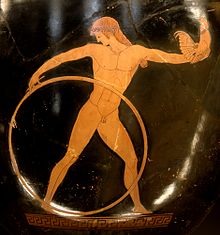
Ganymede rolling a hoop and bearing aloft a cockerel, a love-gift[35] from Zeus, who is pictured in pursuit on the obverse of a vase by the Berlin Painter (Attic red-figure krater, 500–490 B.C.Due east.)

In 5th century Athens, the story of Ganymede became popular amid vase-painters, which was suited to the all-male symposium.[36] Ganymede was usually depicted equally a muscular beau, although Greek and Roman sculpture typically depicted his physique as less developed than athletes'.[37]
One of the earliest depictions of Ganymede is a red-effigy krater by the Berlin Painter in the Musée du Louvre.[38] Zeus pursues Ganymede on one side, while on the other side the youth runs away, rolling along a hoop while holding aloft a exultation erect. The Ganymede myth was treated in recognizable contemporary terms, illustrated with common behavior of homoerotic courtship rituals, as on a vase by the "Achilles Painter" where Ganymede also flees with a cock. Cocks were mutual gifts from older male person suitors to younger men they were interested in romantically in 5th century Athens.[36] Leochares (ca. 350 B.C.East.), a Greek sculptor of Athens who was engaged with Scopas on the Mausoleum at Halicarnassus bandage a lost bronze group of Ganymede and the Eagle, a work that was held remarkable for its ingenious composition.[36] It is patently copied in a well-known marble group in the Vatican.[39] Such Hellenistic gravity-defying feats were influential in the sculpture of the Baroque.
Ganymede and Zeus in the guise of an eagle were a pop discipline on Roman funerary monuments with at least xvi sarcophagi depicting this scene.[37]
Renaissance and Baroque [edit]
Ganymede was a major symbol of homosexual dearest in the visual and literary arts from the Renaissance to the Tardily Victorian era, when Antinous, the reported lover of the Roman Emperor Hadrian, became a more than popular subject area.[40]
In Shakespeare'south Every bit Y'all Like It (1599), a comedy of mistaken identity in the magical setting of the Woods of Arden, Celia, dressed every bit a shepherdess, becomes "Aliena" (Latin "stranger", Ganymede'southward sister) and Rosalind, because she is "more than mutual tall", dresses up as a male child, Ganymede, a well-known epitome to the audition. She plays on her cryptic charm to seduce Orlando, but also (involuntarily) the shepherdess Phoebe. Thus behind the conventions of Elizabethan theater in its original setting, the young male child playing the girl Rosalind dresses up as a boy and is then courted by another male child playing Phoebe. Ganymede likewise appears in the opening of Christopher Marlowe play Dido, Queen of Carthage, where his and Zeus's appreciating barrack is interrupted past an angry Aphrodite (Venus).[41] In later on Jacobean tragedy, Women Beware Women, Ganymede, Hebe, and Hymen briefly appear to serve every bit cupbearers to the court, 1 of which has been poisoned in an assassination effort, although the plan goes awry.[42]
Allusions to Ganymede occur with some frequency in 17th century Spanish theater. In El castigo sin venganza (1631) by Lope de Vega, Federico, the son of the Duke of Mantua, rescues Casandra, his hereafter step-female parent, and the pair will later develop an incestuous human relationship. To emphasize the non-normative relation, the piece of work includes a long passage, perchance an ekphrasis derived from Italian art, in which Jupiter in the grade of an eagle abducts Ganymede.[43] Two plays past Tirso de Molina, and in particular La prudencia en la mujer, include intriguing references to Ganymede. In this particular play, a Jewish dr. who seeks to toxicant the future rex, carries a cup which is compared to Ganymede's.[44]
One of the earliest surviving non-aboriginal depictions of Ganymede is a woodcut from the outset edition of Emblemata (ca. 1531), which shows the youth riding the hawkeye as opposed to beingness carried away, however, this composition is probable not typical, as an earlier composition past Michelangelo that survives only every bit sketches depicts Ganymede being carried.[45] Painter-architect Baldassare Peruzzi included a panel of The Rape of Ganymede in a ceiling at the Villa Farnesina, Rome, (ca 1509–1514), Ganymede'south long blond hair and girlish pose make him identifiable at outset glance, though he grasps the eagle'southward wing without resistance. In Antonio Allegri Correggio'southward Ganymede Abducted by the Hawkeye (Vienna) Ganymede's grasp is more intimate. Rubens' version portrays a boyfriend. But when Rembrandt painted the Rape of Ganymede for a Dutch Calvinist patron in 1635, a dark eagle carries aloft a plump cherubic baby (Paintings Gallery, Dresden) who is bawling and urinating in fright.[46] In contrast, Johann Wilhelm Baur portrays a full-grown Ganymede confidently riding the hawkeye towards Olympus in Ganymede Triumphant (ca. 1640s).[45] A 1685 statue of Ganymede and Zeus entitled Ganymède Médicis by Pierre Laviron stands in the gardens of Versailles.
Examples of Ganymede in 18th century France accept been studied by Michael Preston Worley.[47] The image of Ganymede was invariably that of a naive adolescent accompanied past an eagle and the homoerotic aspects of the fable were rarely dealt with. In fact, the story was ofttimes sexualized. Moreover, the Neoplatonic interpretation of the myth, so common in the Italian Renaissance, in which the rape of Ganymede represented the ascent to spiritual perfection, seemed to exist of no interest to Enlightenment philosophers and mythographers. Jean-Baptiste Marie Pierre, Charles-Joseph Natoire, Guillaume II Coustou, Pierre Julien, Jean-Baptiste Regnault and others contributed images of Ganymede to French art during this menses.
-

The Rape of Ganymede (1611) past Rubens
-

-

The Induction of Ganymede in Olympus (1768) by van Loo
-

Ganymède Médicis (1684-1685) by Pierre Laviron at Versailles.
Modern [edit]
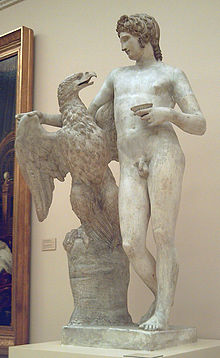

Statue of Ganymed at the lake Zurich

"'Modern Version of Ganymede' Introduction of Budweiser to the Gods": advert in Theatre Magazine, February 1906
- José Álvarez Cubero's sculpture of Ganymede, executed in Paris in 1804, brought the Spanish sculptor immediate recognition as one of the leading sculptors of his twenty-four hours.[48]
- Vollmer's Wörterbuch der Mythologie aller Völker,[49] (Stuttgart, 1874) illustrates "Ganymede" by an engraving of a "Roman relief," showing a seated disguised Zeus who holds the cup aside to depict a naked Ganymede into his cover. That engraving nonetheless was nothing simply a copy of Raphael Mengs'south apocryphal Roman fresco, painted equally a applied joke on the eighteenth-century fine art critic Johann Winckelmann who was growing desperate in his search for homoerotic Greek and Roman antiquities. This story is very briefly told by Goethe in his Italienische Reise.[l]
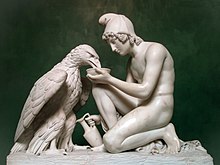
- At Chatsworth in the nineteenth century the bachelor Duke of Devonshire added to his sculpture gallery Adamo Tadolini's Neoclassic "Ganymede and the Eagle," in which a luxuriously reclining Ganymede, embraced by 1 wing, prepares to commutation a peck with the hawkeye. The delicate loving cup in his manus is made of gold-bronze, lending an unsettling immediacy and realism to the white marble group.
- In the early years of the twentieth century, the topos of Ganymede'southward abduction by Zeus was drafted into the service of commercial enterprise. Adapting an 1892 lithograph by Frank Kirchbach, the brewery of Anheuser-Busch launched in 1904 an advertizement campaign publicizing the successes of Budweiser beer. Collectibles featuring the graphics of the poster connected to be produced into the early 1990s.
- The verse form "Ganymed" past Goethe was set up to music by Franz Schubert in 1817; published in his Opus 19, no. 3 (D. 544). Also fix by Hugo Wolf.
- The Portuguese sculptor António Fernandes de Sá represented the abduction of Ganymede in 1898. The sculpture can exist plant in Jardim da Cordoaria, in Porto (Portugal).
- In stories by P. G. Wodehouse, the Junior Ganymede is a servants' club, analogous to the Drones, to which Jeeves belongs. Wodehouse named information technology after Ganymede presumably in reference to his role of cup-bearer.
- Ganymede is a reluctant music fan in Kurtis Blow's 1980 song "Way Out West". Later on hours of rap past "The Stranger" (Kurtis), he somewhen gets up to trip the light fantastic.
- American artist Henry Oliver Walker painted a landscape in the Library of Congress in Washington D.C. circa 1900, depicting an adolescent, nude Ganymede on the dorsum of an hawkeye.
- Ganymede and the god Dionysus brand an appearance in Everworld VI: Fearfulness the Fantastic, of Thou.A. Applegate's fantasy serial Everworld. Ganymede is described as alluring both males and females.
My outset idea, my first flash was that it was a beautiful adult female.... The angel was beautiful, with a face dominated by immense, lustrous green eyes and framed past gold ringlets, and with a bow rima oris and full lips and brilliant white teeth.
And only then, only later I had felt that first rush of improbable carnal lust, did it occur to me that this affections was a homo.[51]
- In 1959 Robert Rauschenberg referenced the myth in one of his best-known works, Canyon and in another work, Pail for Ganymede. In "Canyon", a photo of Rauschenberg's son Christopher beautifully reiterates the babe portrayed past Rembrandt in the 17th century. A blimp hawkeye emerges from the flat picture show airplane with a pillow tied to a piece of string very near his hook. The pillow besides reflects upon the young boy'due south body and Rembrandt'due south painting.
- Ganymede is a reluctant son in West.H.Auden'south poem of that name, but he adores the hawkeye which teaches him how to kill.
- Felice Picano'south 1981 novel An Asian Minor reinvents the story of Ganymede.
- In the 2016 video game Overwatch, the character Bastion has a bird named Ganymede.
- A character in the Terra Ignota series past Ada Palmer is named Ganymede de la Trémoille
- The opening of Volition Self's 2017 novel Phone refers to 'agents of Ganymede' (p. six) to explore caution within the homosexual community in previous decades.
- The commencement verse form in Jericho Brown'due south Pulitzer Prize for Poetry-winning 2019 book The Tradition is titled "Ganymede." Brown, who frequently interrogates topics of sexuality and race, brings the Greek abduction myth into contact with the history of American slavery.
Family unit tree [edit]
| |||||||||||||||||||||||||||||||||||||||||||||||||||||||||||||||||||||||||||||||||||||||||||||||||||||||||||||||||||||||||||||||||||||||||||||||||||||||||||||||||||||||||||||||||||||||||||||||||||||||||||||||||||||||||||||||||||||||||||||||||||||||||||||||||||||||||||||||||||||||||||||||||||||||||||||||||||||||||||||||||||||||||||||||||||||||||||||||||||||||||||||||||||||||||||||||||||||||||||||||||||||||||||||||||||||||||||||||||||||||||||||||||||||||||||||||||||||||||||||||||||||||||||||||||||||||||||||||||||||||||||||||||||||||||||||||||||||||||||||||||||||||||||||||||||||||||||||||||||||||||||||||||||||||||||||||||||||||||||||||||||||||||||||||||||||||||||||||||||||||||||||||||||||||||||||||||||||||||||||||||||||||||||||||||||||||||||||||||||||||||||||||||||||||||||||||||||||||||||||||||||||||||||||||||||||||||||||||||||||||||||||||||||||||||||||||||||||||||||||||||||||||||||||||||||||||||||||||||||||||||||||||||||||||||||||||||||||||||||||||||||||||||||||||||||||||||||||||||||||||
Notes [edit]
- ^ Some variants of the myth accept Ganymede snatched from Harpagion instead.[twenty]
References [edit]
- ^ "Ganymede". Oxford English Lexicon (Online ed.). Oxford University Press. (Subscription or participating institution membership required.)
- ^ "Ganymedes". Dictionary.com Unabridged (Online). n.d.
- ^ Lattimore, Richard, trans. The Iliad of Homer. Chicago: University of Chicago Press, 1951.
- ^ According to AMHER (2000), catamite, p. 291.
- ^ "Plato: Laws". Perseus Digital Library. 636C. Retrieved 2020-03-13 .
- ^ Diodorus Siculus, Bibliotheca historica 4.75.3–five
- ^ Homer, Iliad 20.230–240
- ^ Suda v.s. Minos
- ^ Tzetzes on Lycophron, 29
- ^ Scholiast on Homer's Iliad xx.231 who refers to Hellanicus as his authority
- ^ Pseudo-Apollodorus, Bibliotheca 3.12.2
- ^ Dionysius of Halicarnassus, Antiquitates Romanae 1.62.ii
- ^ Dictys Cretensis, Trojan War Chronicle 4.22
- ^ Cicero, Tusculanae Disputationes 1.65
- ^ Euripides, Troad 822
- ^ Tzetzes ad Lycophron 34
- ^ Clement of Alexandria, Recognitions 22
- ^ Hyginus, Fabulae 224
- ^ Hyginus, Fabulae 271
- ^ Strabo. "Geography thirteen.1.eleven". Perseus Digital Library. Tufts University. Retrieved 19 March 2020.
- ^ Virgil, Aeneid, 5.252
- ^ Homer, Iliad 20.230
- ^ Combellack, Frederick Thousand. (1987). "The lusis ek ths lecews". The American Journal of Philology. 108 (2): 202–219. doi:10.2307/294813. JSTOR 294813.
- ^ Edmund Veckenstedt, Ganymedes, Libau, 1881.
- ^ Virgil, Aeneid, 1.28
- ^ Marshall, David Weston (2018). Aboriginal Skies: Constellation Mythology of the Greeks. New York, NY: The Countryman Press. pp. 45–46. ISBN978-1682682111.
- ^ Marius/Schlör, Mundus Iovialis, p. 78 f. (with misprint In for Io)
- ^ The Achaean Diomedes is corking to capture the horses of Aeneas because "...they are of that stock wherefrom Zeus, whose voice is borne afar, gave to Tros recompense for his son Ganymedes, for that they were the best of all horses that are beneath the dawn and the sunday.": Homer, Iliad 5.265ff.
- ^ Plato, Laws 636D, as cited by Thomas Hubbard, Homosexuality in Greece and Rome, p252
- ^ a b Koehl, Robert B. (1986). "The Chieftain Cup and a Minoan Rite of Passage". The Periodical of Hellenic Studies. 106: 99–110. doi:x.2307/629645. JSTOR 629645.
- ^ Xenophon, Symposium viii.29–30; Craig Williams, Roman Homosexuality (Oxford University Press, 1999, 2010), p. 153.
- ^ Apollonius Rhodius, Argonautica 3.112
- ^ Virgil, Aeneid 5.256–7.
- ^ Statius, Thebaid 1.549.
- ^ For the cockerel as an emblematic souvenir to the eromenos, come across, for example, H.A. Shapiro, "Courting scenes in Attic vase-painting", American Journal of Archeology, 1981; the gift is "gender specific, and it is clear that the cock had significance as evocative of male potency", T.J. Figueira observes, in reviewing two recent works on Greek pederasty, in American Journal of Archaeology, 1981.
- ^ a b c Woodford, Susan (1993). The Trojan War in Ancient Art. Ithaca, NY: Cornell Academy Press. p. 39. ISBN978-0801481642.
- ^ a b Bartman, Elizabeth (2002). "Eros'due south Flame: Images of Sexy Boys in Roman Platonic Sculpture". Memoirs of the American Academy in Rome. Supplementary Volumes 1: 249–271. JSTOR 4238454.
- ^ "world wide web.louvre.fr".
- ^ D'Souza, J.P. (1947). "The Story of Vasu Uparichara and Its Sumerian, Greek and Roman Parallels". Proceedings of the Indian History Congress. 10: 171–176. JSTOR 44137123.
- ^ Waters, Sarah (1995). ""The Nigh Famous Fairy in History": Antinous and Homosexual Fantasy". Journal of the History of Sexuality. half-dozen (two): 194–230. JSTOR 3704122.
- ^ Williams, Deanne (2006). "Dido, Queen of England". ELH. 73 (1): 31–59. doi:10.1353/elh.2006.0010. JSTOR 30030002.
- ^ Levin, Richard A. (1997). "The Dark Color of a Cardinal'southward Discontentment: The Political Plot of "Women Beware Women"". Medieval & Renaissance Drama in England. 10: 201–217. JSTOR 24322350.
- ^ Frederick A. de Armas, "From Mantua to Madrid: The License of Desire in Giulio Romano, Correggio and Lope de Vega's El castigo sin venganza" Bulletin of the Comediantes59.two (2008): 233–65.
- ^ Felipe E. Rojas, "Representing An-'Other' Ganymede: The Multi-Faceted Character of Ismael in Tirso de Molina'southward La prudencia en la mujer (1634)," Message of Hispanic Studies (2014): 347–64.
- ^ a b Orgel, Stephen (2004). "Ganymede Agonistes". GLQ: A Journal of Lesbian and Gay Studies. 10 (iii): 485–501. doi:10.1215/10642684-ten-three-485.
- ^ Barfoot, C.C.; Todd, Richard. The Keen Emporium : the Low Countries as cultural crossroads in the Renaissance and the eighteenth century. Amsterdam: Editions Rodopi B.V.
- ^ Worley, "The Epitome of Ganymede in French republic, 1730–1820: The Survival of a Homoerotic Myth," Fine art Bulletin 76 (Dec 1994: 630–643).
- ^ One or more of the preceding sentences incorporates text from a publication now in the public domain:Chisholm, Hugh, ed. (1911). "Alvarez, Don José". Encyclopædia Britannica (11th ed.). Cambridge University Press.
- ^ "Vollmer-mythologie.de". Vollmer-mythologie.de. Retrieved 2014-01-22 .
- ^ "Textlog.de". Textlog.de. Retrieved 2014-01-22 .
- ^ Applegate, K. A., Everworld Half dozen: Fear the Fantastic, p. fifty.

Sources [edit]
Ancient sources [edit]
Ganymede is named by diverse aboriginal Greek and Roman authors:
- Homer – Iliad five.265; Iliad 20.232;
- Homerica – The Fiddling Iliad, Frag 7;
- Homeric Hymns – Hymn 5, To Aphrodite, 203–217;
- Theognis – Fragments 1.1345;
- Pindar – Olympian Odes one; 11;
- Euripides – Iphigenia at Aulis 1051;
- Plato – Phaedrus 255; Laws 636c
- Apollonios Rhodios – Argonautica 3.112f;
- ps-Apollodorus – Bibliotheke 2.104; 3.141;
- Strabo – Geography 13.1.11;
- Pausanias – Guide to Greece V.24.v; 5.26.2–3;
- Diodorus Siculus – The Library of History 4.75.three;
- Hyginus
- Fabulae 89; 224; 271;
- Astronomica 2.16; 2.29;
- Ovid – Metamorphoses 10.152;
- Virgil – Aeneid i.28; 5.252;
- Cicero – De Natura Deorum i.40;
- Valerius Flaccus – Argonautica 2.414; 5.690;
- Statius
- Thebaid one.549;
- Silvae three.iv.13;
- Apuleius – The Aureate Donkey 6.15; 6.24;
- Quintus Smyrnaeus – Fall of Troy 8.427; fourteen.324;
- Nonnus – Dionysiaca 8.93; 10.258; x.308; 12.39; 14.430; 15.279; 17.76; xix.158; 25.430; 27.241; 31.252; 33.74; 39.67; 47.98;
- Suda – Ilion; Minos;
Modern sources [edit]
- This commodity incorporates text from a publication now in the public domain:Chisholm, Hugh, ed. (1911). "Ganymede". Encyclopædia Britannica. Vol. 11 (11th ed.). Cambridge University Press. p. 454.
External links [edit]
 | Wikimedia Commons has media related to Ganymede. |

- World History of Male Love: Zeus and Ganymede
- The Zeus and Ganymede Myth: Analysis and Resources past Andrew Calimach
- Ganymedes, Theoi Projection
- Ganymede: Subject of the Visual Arts
- Goethe, "Ganymed" (in High german)
- Warburg Institute Iconographic Database (ca 200 images of Ganymede) Archived 2016-03-04 at the Wayback Machine
Source: https://en.wikipedia.org/wiki/Ganymede_(mythology)
0 Response to "Church Impact on Art in Renaissance Zeus and Ganymeded"
Enviar um comentário